

Placing a home battery outside: is that possible?
You can place a home battery outside if the manufacturer has approved the model for outdoor use and you put it in a sheltered spot. Below, you'll read which rules apply, which requirements an outdoor battery meets and how to set up the outdoor installation.
Can a home battery stand outside?
A home battery is allowed to stand outside, because Dutch building regulations set no separate requirements for the location where you place a home battery. The battery is, however, part of your home's electrical installation, which under the Besluit bouwwerken leefomgeving (Bbl) must comply with the installation standard NEN 1010. Whether a specific home battery can be placed outside is determined by the manufacturer in the manual.
So a model that the manufacturer only intends for indoor use shouldn't be placed outside, not even under a canopy. A model approved for outdoor use can be placed there, as long as you follow the placement requirements from that same manual.
When is a home battery suitable for outdoor use?
A home battery is suitable for outdoor use if the housing keeps out dust and water and the battery can keep charging during frost. You can find both properties in the datasheet, and they are independent of each other: a waterproof battery can still stop charging during frost.
IP65 or higher for outdoor use
IP65 or higher is the IP rating you're looking for when it comes to outdoor use, because from IP65 onwards the housing is both dustproof and resistant to water jets from any direction. The IP code comes from the international standard IEC 60529. The first digit refers to dust, the second to water. IP66 goes a step further and also keeps out powerful water jets.
The IP rating only applies as long as the housing is closed. Zendure states that the IP65 protection no longer applies once the off-grid socket is in use or the waterproof cover doesn't close properly.
Self-heating for charging during frost
Self-heating allows an outdoor home battery to charge even during frost, because the battery warms up the cells first. On the Zendure AB3000X and the SolarFlow 4000 Mix AC+, the charging limit is 0 °C, while discharging continues down to -20 °C. On the AB3000X, the self-heating warms the cells between -20 °C and 0 °C using grid or solar power, so that charging can safely resume afterwards.
That warming up uses electricity itself, which on cold days you won't be using for your household. How big that effect is and how to limit it is explained in the article about a home battery in winter.
Which outdoor home battery should you choose?
At TechPunt, you can choose from two brands of outdoor home batteries: Anker SOLIX and Zendure. Which brand suits you best depends mainly on your location, because the manufacturers set different requirements for protection against sun and rain.
Anker SOLIX Solarbank with IP66
The Anker SOLIX Solarbank with IP66 is made for both indoor and outdoor use: the Solarbank Max AC datasheet lists both as installation locations. The housing works between -20 °C and 55 °C and cools via natural convection, so without a fan.
The Solarbank 4 E5000 Pro has the same IP rating and the same temperature range. You'll find the full range at the Anker SOLIX home batteries.
Zendure SolarFlow under a canopy
A Zendure SolarFlow goes outdoors under a lean-to, carport or canopy. Zendure allows both indoor and outdoor placement of the SolarFlow 2400 AC+, but despite the IP65 housing it asks you to avoid direct sun and rain.
For the SolarFlow 4000 Mix AC+, Zendure also requires a shaded spot. A canopy above it meets both requirements and lets you choose from the Zendure home batteries that the manufacturer has approved for outdoor use.
Where is the best place to put a home battery outdoors?
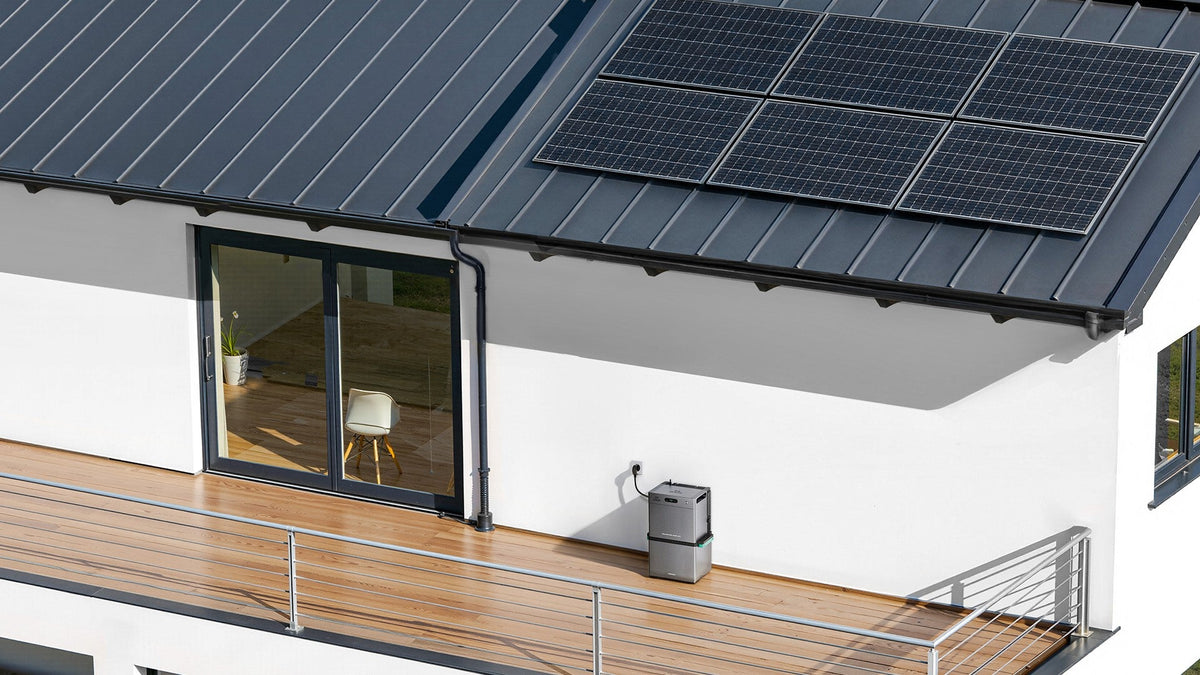
A home battery placed outdoors is best positioned in a sturdy, shaded spot, close to a suitable power socket. When choosing that spot, keep the following points in mind:
- Wall: place the battery against a brick wall on the shaded side of the house.
- Surface: choose a flat, sturdy and non-flammable surface, as the fire brigade advises. Place the battery raised up, away from puddles and rising damp, for example on the mounting base for the Solarbank Max AC from the accessories for your home battery.
- Clearance: keep space around the battery free for cooling. Zendure requires at least 15 cm above and 5 cm behind the SolarFlow 2400 AC+.
- Escape route: keep the battery out of your escape route, so not right next to the door you'd use to leave the house in case of fire.
- Sound: don't choose a spot directly beneath a bedroom window. According to Zendure, the SolarFlow 4000 Mix AC+ produces 40 to 43 dB at full power from 1 metre away.
- Power socket: connect a battery with a plug directly to an earthed wall socket, preferably on its own circuit and without an extension cord, as Anker recommends. A new outdoor socket should be installed by a certified electrician.
- Cable length: the AC cable included with the SolarFlow 2400 AC+ is 3 metres long. For an Anker Solarbank, 5- and 15-metre AC cables are available separately, also with a lockable Wieland plug.
- Balcony: if you want to place a home battery outdoors on your balcony, check whether the balcony can bear the weight; the SolarFlow 4000 Mix AC+ weighs 80 kilos, for example. In an apartment or rental home, ask the homeowners' association or landlord for permission in advance.
If you can't find a spot that meets all these points, a place indoors or in an outbuilding is usually the better choice. There the battery stays dry and the distance to the meter cabinet is often shorter.
Is a home battery safer outdoors than indoors?
A home battery outdoors is safer for residents than indoors, because smoke and gases can escape straight into the open air in the event of an incident. The Netherlands Institute for Public Safety (NIPV) concluded in a report from December 2024 that an incident with a battery placed outdoors would then not directly threaten the residents. The fire department can also reach the battery outdoors more easily and safely.
The NIPV did question whether batteries can handle outdoor temperatures, and saw a separate indoor space with smoke detection as a realistic alternative. For outdoor models, that concern is smaller, because the operating range is tuned to the outdoor climate. Want to know how high the risk of fire is and how to reduce it? Then check out the article on the fire risk of a home battery.
What extra care does an outdoor home battery setup require?
An outdoor home battery setup calls for extra care on three points that barely matter indoors. So with an outdoor battery, keep the following in mind:
- Security: a battery on the front facade stands out from the street. Choose a spot at the back and secure the battery with a wall mount or anchoring in the floor.
- Insurance: the fire department advises informing your insurer about the installation. While you're at it, ask whether a battery outside an enclosed space is covered by your policy.
- Maintenance: after a storm or frost, check the cables, seals and covers, and keep the ventilation openings free of leaves and dirt. Only clean the housing with a dry cloth, as Zendure recommends.
Combine that check with the monthly dusting from the fire department's maintenance tips. That way you'll spot small defects in time, before they affect the battery's performance.
Not sure where to place your home battery outdoors?
Not sure where to place your home battery outdoors? The TechPunt advisors are happy to help. Get in touch by phone, email or WhatsApp and tell us where you'd like to put the battery.
We compare your situation against the installation requirements of Anker SOLIX and Zendure, so you know whether your facade, carport or balcony is suitable and which model fits there. If you then choose a home battery, we'll ship it from our own warehouse in Barneveld.


